The 2026 Bassmaster Elite Series stop at Lake Murray, South Carolina, was the talking point of episode 8 of The Bass Draft, with Andrew Upshaw, Ish Monroe, Todd Castledine and Matt Pangrac joined by Bass Pro Tour pro Britt Meyers — a Carolina local who arguably knows the lake better than anyone else on the panel.
The twist this week was that Murray was confirmed late as a forward-facing-sonar event, after a couple of the panel had been preparing for a no-scope ruling. "I didn't know it was a live scope event though," Upshaw said as the order shook out. "I was ready to pick all." Once the rulebook landed, the panel pivoted to the question that's been hanging over Carolina events since FFS arrived: how much does the technology still help on a herring-spawn lake, and how much does it disrupt the way the locals have always fished?
Meyers' read was direct. "Those Carolina fish are used to the live scope by now," he said. "It's not just sea cast catch count and count anymore." Upshaw, talking about home water rather than Murray specifically, took the broader-brush view. "If forward facing sonar is like a giant deal on a lake, it has totally disrupted that, like changed it," he said. "All that stuff that I [fished] for 20 years, man — I don't know if I can go back and do any of that stuff anymore."
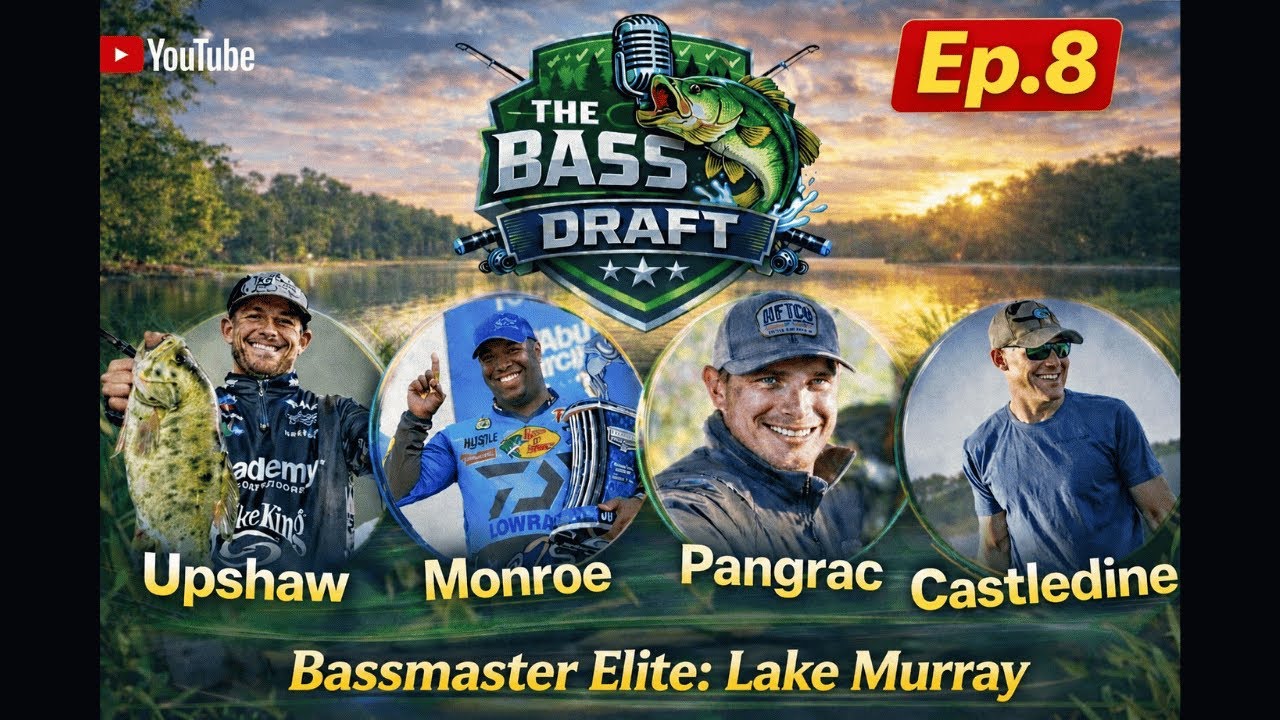
The drafting moved fast. Upshaw led with Trey McKinney; Castledine answered with Kyle "Father Gil" Welcher; Ish Monroe went Cody "Coyo" Huff at three; Meyers used his first pick on Fisher Nia and his second on Patrick Walters — a name the room considered a quiet steal. "Patrick is old school scope," Meyers said, "but he gets the blue back herring stuff."
In the second round, Castledine reached for Emil Wagner with a strategy answer that doubled as inside-baseball gossip. "Have you seen the man on spotted bass legs? Him and Paul Marx are like buddies," he said. "Mil dominates on Lanier and every time Paul goes to Lanier they... I think those two work together." Meyers signed off on the read. "That is a correct gut feeling."
Meyers' own second-round pick was the show's headline. "I'm going with Brandon Cobb," he said, before laying out the local-knowledge case. "He lives less than an hour from there. He finished second to Forestwood Cup working with Justin Hackney. He's going to know where to be. You could get on one spot and you can literally just wait for him to come up or wait for him to get active." The panel's consensus on Murray, repeated several times, came back to the same thread: herring fish move on shallow points, the points don't change, and the right boat sitting on the right point is everything. "It's like musical chairs," Meyers said. "If you don't get one of those really good spots, then you don't have a chance."
Pangrac's third- and fourth-round picks were arguably the most pointed of the night. He took JT Tompkins in the third round and called him a "steal," then doubled down on local intel for round four. "This is a Hamner event," he said. "The exact week they were here in 2014, JT Tompkins finished in third place and Hamner finished in 16th. So I feel like those are two steals." The room didn't push back. Hamner has won big on a Carolina herring lake before, knows the run of bites, and is a known player when there's repetition in the area.
Meyers also liked Shane LeHew over Jason Williamson on a value call. "Shane is just far enough away from there to be deadly," he said. "No one's picking Jason Williamson, guys. He's strong." Late-round names floated for value: Sam Hangy, Caleb Hudson (the rookie pick), Tucker Smith, and Hunter Shyrock — flagged by Castledine as a sleeper. "He's on the baby pattern because he's got one on the way," Castledine said. "He did good last time they were there."
The room also worked through the herring-spawn timing question. Upshaw asked whether the spawn would still be running when boats hit the water. Meyers' answer — "Should be, or late" — kicked off a sub-debate on whether the timing actually negates a forward-facing-sonar advantage for anglers good at intercepting cruising fish in two feet of water. "I do know it works on that herring deal," Meyers said, "and those guys who are really good at it are good with it in two foot of water."
For anglers tuning in, the FFS-versus-traditional debate that hovered over the whole show is probably the lasting story. "It's like musical chairs," Meyers said again as the panel wound down. "It's still a points lake. It's still a herring lake. Some things don't change."