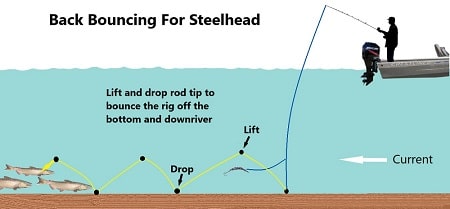
Fishing for steelhead can be a rewarding challenge, especially when employing the back bouncing technique. Having spent over thirty years refining my skills at this craft, I have gathered insights not only from personal experiences but also from many seasoned guides. In certain river conditions, back bouncing often proves to be the most effective method for landing these stunning fish.
"This technique isn’t just effective for Steelhead, but it also proves its worth with Coho salmon and King salmon," I explained, underscoring its versatility. Furthermore, those fishing in the Great Lakes region will find success targeting migratory brown trout and Atlantic Salmon using the same method.
"This technique isn’t just effective for Steelhead, but it also proves its worth with Coho salmon and King salmon,"


Understanding Back Bouncing for Steelhead
At its core, back bouncing is a method designed for swift or deeper river fishing. "The concept is simple: you drop a substantial weight along with a bait or lure to the river's bottom," I noted. Once in position, the goal is to entice steelhead by letting the bait flow naturally with the current. This is achieved by rhythmically lifting and lowering the weight every 5 to 20 seconds, which helps present the bait downstream effectively.
"The concept is simple: you drop a substantial weight along with a bait or lure to the river's bottom,"
Back bouncing is a highly adaptable technique, working exceptionally well on the West Coast rivers, as well as those around the Great Lakes. "It is equally good when back bouncing for salmon," I added, showcasing its universal appeal among anglers.
"It is equally good when back bouncing for salmon,"
Mastering the Back-Bouncing Method
"With the right weight, the right bait, and a proven back bouncing rig, fishing with this technique is actually easy," I said, emphasizing how straightforward the process can be. Whether you're releasing weight from the back of a boat or casting into a specific spot, the core steps remain consistent.
First, you need to drop your weight to the bottom. "As the weight reaches the riverbed, you’ll feel a distinctive thud," I explained. When using bait, you can be confident it will create a scent trail, increasing your enticement.
"As the weight reaches the riverbed, you’ll feel a distinctive thud,"
Next, aim to keep your rod tip around eye level. After a brief pause of 5 to 10 seconds, raise your rod tip sharply. "Let the line free spool out as you lower your rod tip back to eye level and stop the line," I clarified. This motion allows your rig to ascend and facilitates the bait's downstream movement.
"Let the line free spool out as you lower your rod tip back to eye level and stop the line,"
It’s essential to repeat this motion consistently, allowing your line to extend while remaining aware of any bites or the weight’s position. "I advise stopping your line when it reaches a 45-degree angle from the water’s surface," I advised. Keeping this tactile connection is crucial for success.
"I advise stopping your line when it reaches a 45-degree angle from the water’s surface,"
Back Bouncing from Your Boat
Many anglers favor the boat approach when back bouncing, which is often the most effective strategy. "For most anglers, back bouncing from a boat is the go-to approach, and for good reason – it’s highly effective," I elaborated while discussing the method used in various settings.
"For most anglers, back bouncing from a boat is the go-to approach, and for good reason – it’s highly effective,"
When anchored, positioning your boat upstream from the target spot allows for precise bait manipulation downstream using your rod. Alternatively, some prefer to slowly move the boat while lifting the rod—a modified approach that helps cover more water efficiently. "This approach effectively covers more ground downstream," I stated, highlighting the need to adapt based on conditions.
"This approach effectively covers more ground downstream,"
Back Bouncing from the Shore or While Wading
Not all fishing needs to occur from a boat; indeed, back bouncing can be just as effective while wading or from the shoreline. This versatility allows even those without boat access to leverage this technique. "If you’re not on a boat, don’t worry. Back bouncing can still be highly productive when wading," I assured interested anglers, providing them with hope and encouragement to try these methods themselves.
As more anglers seek out steelhead this season, understanding how to effectively implement back bouncing could significantly enhance their fishing experience. By mastering this technique, anglers may find themselves with increased success rates and deeper satisfaction from their time on the water.