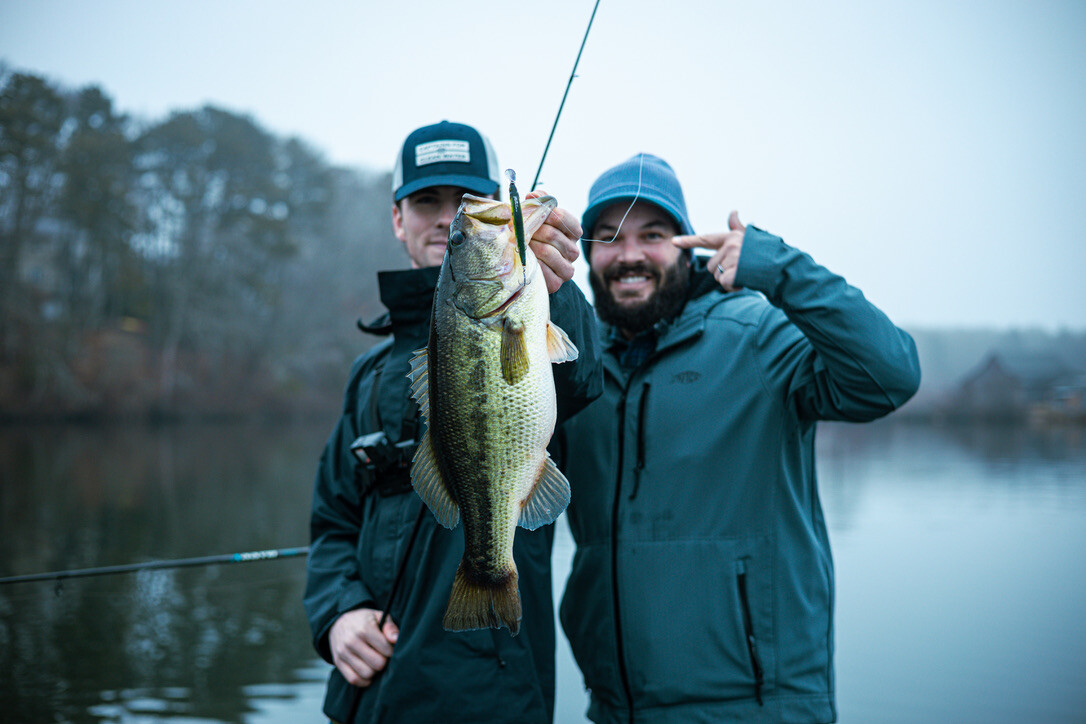
Jerkbaits are a staple in the arsenal of anglers pursuing bass, offering versatility that spans from the heart of spring fishing to the chilly months of winter. These lures mimic the swim of a distressed minnow and can entice bites in various freshwater settings. To maximize success, understanding the nuances of jerkbait fishing is key.
Jeff Gustafson, a seasoned pro from the Bassmaster Elite Series, emphasizes the importance of having quality gear. "I use a G. Loomis 7'1'' IMX Pro spinning rod paired with a Shimano Stradic CI4 2500 reel," said Gustafson. His choice of line is equally specific, employing 10-pound PowerPro Super8Slick V2 braid along with a 6- to 8-foot fluoro leader. For bait, he opts for the Jackall DD Squirrel, showcasing his strategy for targeting bass effectively.
Like Gustafson, fellow angler Mike McClelland from Major League Fishing also highlights the importance of tailor-made setups. "I prefer a Falcon 6'8'' Mike McClelland Signature Series Cara ST Micro jerkbait rod combined with a Cabela's casting reel," said McClelland. When the water temperature drops below 48 degrees, he uses 8- to 14-pound Sunline Super Natural line. These specific choices underscore the significance of adapting equipment based on environmental variables.

"I prefer a Falcon 6'8'' Mike McClelland Signature Series Cara ST Micro jerkbait rod combined with a Cabela's casting reel,"

Race Results
Understanding how to retrieve a jerkbait can be a game-changer in attracting fish. The basic technique involves creating an erratic motion. "Start with the rod pointing down at the 4 o’clock position, then snap the rod to a 5 or 6 o’clock position while keeping some slack in the line," explained one expert. Following this snap, it’s essential to return the rod to the 4 o’clock position while winding in line to accommodate the lure’s movement. The sequence of jerk, pause, and repeat can lead to remarkable results, especially when combined with strategic pauses.

"Start with the rod pointing down at the 4 o’clock position, then snap the rod to a 5 or 6 o’clock position while keeping some slack in the line,"
Variations in retrieve techniques can significantly affect outcomes. "Mixing up your retrieve mechanics not only helps prevent arm fatigue but can also trigger more strikes," Gustafson added, pointing to the importance of experimentation. For instance, he recommends altering the retrieve style for different jerkbait models, stating, “With the deep-diving Jackall DD Squirrel, modify your cadence to a pull-pull-pause instead of the typical twitch-twitch-pause.” This approach applies a subtler presentation, which can be crucial when fish are picky.
"Mixing up your retrieve mechanics not only helps prevent arm fatigue but can also trigger more strikes,"

Race Results
Temperature plays a vital role in determining how aggressive the retrieve should be. As water warms, so does the enthusiasm of the fish—meaning quicker retrieves and shorter pauses may yield better results. According to McClelland, "When the water is warmer, the bass are more aggressive, and that's when a faster retrieval is effective." Conversely, in colder conditions, extending pauses can provoke a reaction from more lethargic bass.
Stephen Browning, another Major League Fishing pro, shares insights on adapting retrieves to prevailing weather conditions. “I’m a mainstream jerk-jerk-pause kind of guy. I start with that, and if it doesn’t work, I’ll start creating different cadences,” Browning remarked. On cloudy days, he finds that bass are often more forgiving with retrieve breaks. “When there’s not a lot of wind, I like to let it sit longer,” he added, reinforcing the importance of being observant and flexible.
Ultimately, the key to successfully fishing a jerkbait lies in remaining adaptable. Start with dependable techniques that had previously yielded success; however, "you have to let the day tell you what the cadence of your retrieve should be," according to Browning. This flexibility and understanding of fish behavior coupled with the right equipment can greatly enhance the chances of landing that elusive catch.
"you have to let the day tell you what the cadence of your retrieve should be,"
As bass fishing continues to evolve, the jerkbait remains a vital lure. By applying these insights and adjusting to changes in weather, water temperature, and fish activity, anglers can improve their jerkbait fishing effectiveness, ensuring a rich experience on the water all year round.