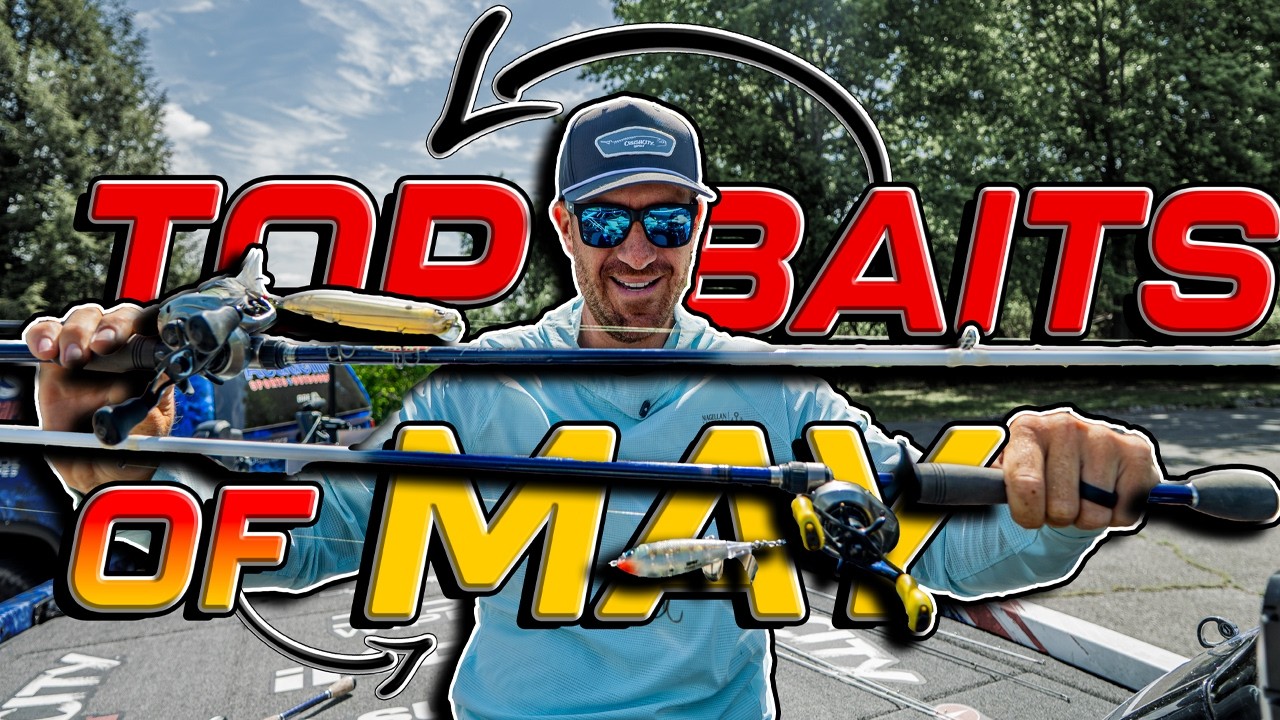
Filming from a Beaver Lake ramp the week before the MLF Bass Pro Tour heads to Grand for stage six, Jacob Wheeler delivered what amounts to a six-bait roadmap for May 2026 bass fishing. His core argument is biological: April belongs to the bass spawn across most of the lower United States, but the post-spawn flips the script across virtually every other forage species in a typical reservoir.
"May is where every other kind of species typically will spawn," Wheeler said. "That's your shad, your forage spawn. That's your bluegill." Out of that, he draws his governing rule for the month. "The biggest thing that changes overall this month is that the bass become the hunter, not the hunted."
The first cast goes to the new Rapala Clap Tail, a plopping-style topwater Wheeler has spent the off-season helping develop. Around the bluegill spawn, he runs the bait fast down banks, through half-moon pockets and across secondary points to find wolfpacking bass on bedding bream. He paired the bait with a 7-foot medium-heavy and a 7.2-to-1 Cast King Skri Reese reel, with monofilament for snap-set anglers and braid for those who prefer a long cast and a pull-set.
When blow-ups don't convert, Wheeler downsizes to a wacky-rigged 5-inch Pig Stick on a 6-foot-10 medium-light, 8-pound braid and a 5mm crossover ring that lets him pivot to a nail weight if the bedding fish are sitting in six feet rather than three. "It does not look like a bluegill," Wheeler said of the soft stick, but he rates it the highest-percentage bluegill-spawn bait in his rotation.
The shad spawn changes everything for an hour each morning. Wheeler estimated his Beaver Lake shad blitz at five clean minutes after sunrise before the lake went silent. "You only got an hour to make hay," he said. He runs a Jowler walking topwater on points and grass, a Rapala Maverick jerkbait when the bass won't come up, and a swim jig - cleaner whites in stained water, more subdued shad colours when the lake is clean - skipped under boat docks and over willow weed. "The more water you cover, the better you're going to find them. And when you do find them, it is magical."
If the lake is choked with cover, Wheeler keeps a frog tied on. "Don't leave home without a frog," he said, fishing a bluegill-pattern model on 50-pound braid and a 7-foot-3 heavy on heavier mats, dropping to a 7-foot-2 medium-heavy on lighter cover. The big-bait card, played selectively, is the glide. Wheeler previewed an unreleased Rapala Glide and was honest about expectations. "Your ratio of how many fish follow the bait and how many fish actually commit to it - if you can get to where it's 10 per cent, you're doing really good."
The finale, and Wheeler's clear favourite, is the offshore push. He fishes a DT16 crankbait on 12-pound fluorocarbon and a 7-foot-6 medium-heavy when the school sets up in 12 to 17 feet, dropping to a DT10 when they slide shallower. When the school is sparse or the crank stops drawing strikes, the Freeloader minnow - 5.25 or 6.25 inches, head size scaled to depth - gets the call. "That's where it really started. That's where we kick this whole thing off," Wheeler said of the bait that helped build his name on Kentucky Lake.
The excitement of finding the right group is real. "When they get out there and you're the first one to find a group of them and there's a hundred of them there, and you cast that crankbait out there and you wind it down, and it just locks up cast after cast after cast, there is nothing better," Wheeler said. He closed with a line that is as much about legacy as tackle. "Take your kids out. Take a kid that's out there on the bank. Take them fishing. If I did not have people in my life that did that to me, I would not be in this position today."